By Mark Ayzenberg, MD, FAAOS, Founder, Iron Mountain Orthopaedic Institute
Chronic tendon pain and stubborn joint conditions have a way of outlasting every treatment you’ve already tried. You’ve done the physical therapy, taken the anti-inflammatories, maybe had a cortisone shot or two. The pain is still there. Now you’re staring at a list of options you don’t fully understand, wondering which one is actually worth your time.
Direct Answer
Extracorporeal Shockwave Therapy (ESWT) is a strong first choice for chronic tendon conditions and calcific deposits that haven’t responded to physical therapy or injections. It works by triggering a controlled mechanical stimulus that restarts the body’s own repair process. For acute injuries, early-stage inflammation, or advanced joint degeneration, other treatments often outperform it.
Key Takeaways
- ESWT is most effective for chronic tendinopathies (plantar fasciitis, Achilles, rotator cuff) that have been unresponsive for at least 3 to 6 months
- PRP and BMAC (stem cell therapy) address tissue regeneration at a cellular level; ESWT addresses it mechanically – they’re not competing, they’re different mechanisms
- Cortisone injections reduce inflammation quickly, but don’t rebuild tissue and can weaken tendons with repeated use
- MLS Laser Therapy works faster for acute pain and inflammation; ESWT works better for calcified or fibrotic tissue
- The worst outcome in chronic tendon care isn’t choosing the wrong non-surgical treatment – it’s waiting so long that surgical options become the only ones left
Why Does Chronic Tendon Pain Keep Coming Back Even After Treatment?
The reason most conservative treatments fail isn’t that they’re ineffective. It’s that they’re targeting the wrong stage of the problem.
Tendinopathy is not a single condition. It’s a spectrum. Early-stage tendinopathy involves reactive inflammation. Chronic tendinopathy involves disorganized collagen, failed healing, and sometimes calcific deposits. A treatment that works brilliantly at stage one (say, a corticosteroid injection for acute bursitis) can be actively counterproductive at stage three, where the tissue needs mechanical stimulation to restart repair rather than suppression.
Most patients arrive at a shockwave conversation after months or years of treatments that were appropriate for a problem they no longer have.
That’s the root cause of the cycle. The injury evolved; the treatment plan didn’t.
What Is ESWT and How Does It Actually Work?
Extracorporeal Shockwave Therapy is a non-invasive procedure that delivers high-energy acoustic pressure waves to targeted musculoskeletal tissue through the skin. The “extracorporeal” part means the energy source stays outside the body.
The mechanism matters here. ESWT doesn’t just mask pain. The acoustic waves create microtrauma in the treated tissue, which triggers a fresh inflammatory response in tissue that had essentially gone dormant. That controlled restart activates growth factors, stimulates neovascularization (the formation of new blood vessels), and breaks down calcific deposits. In other words, it tells the body to treat a chronic injury as if it’s new again.
This is why ESWT tends to work where cortisone failed. Cortisone suppresses inflammation. ESWT provokes a controlled, therapeutic version of it. For tissue that’s been stuck in a failed-healing loop, suppression isn’t the answer.
The treatment itself typically takes 15 to 20 minutes per session. Most protocols involve 3 to 5 sessions spaced one week apart. Discomfort during treatment is real but brief. Improvement is usually gradual over 6 to 12 weeks as tissue remodels.
How Does ESWT Compare to the Other Main Options?
Here’s the honest breakdown. Each treatment has a specific mechanism, target, and failure mode.
| Treatment | Best For | Mechanism | Limitations |
|---|---|---|---|
| ESWT | Chronic tendinopathy, calcific deposits, plantar fasciitis | Mechanical microtrauma triggers repair restart | Less effective for acute injuries, early inflammation |
| PRP (Platelet-Rich Plasma) | Partial tendon tears, early-to-mid arthritis, ligament injuries | Growth factors from your own blood stimulate cell repair | Requires adequate platelet concentration; not ideal for advanced joint destruction |
| BMAC (Stem Cell Therapy) | Cartilage damage, moderate joint degeneration | Bone marrow-derived cells differentiate and regenerate tissue | Higher cost; best reserved for significant structural loss |
| MLS Laser Therapy | Acute pain, post-surgical recovery, nerve pain | Photobiomodulation reduces inflammation and accelerates cellular healing | Less penetrating for deep calcific or fibrotic tissue |
| A2M (Alpha-2-Macroglobulin) | Early-to-moderate osteoarthritis | Binds and neutralizes cartilage-destroying enzymes | Targeted specifically at arthritis progression, not a tendon treatment |
| Corticosteroid Injection | Acute inflammatory flares, bursitis | Suppresses the inflammatory cascade | Doesn’t rebuild tissue; repeated use can weaken tendons and accelerate degeneration |
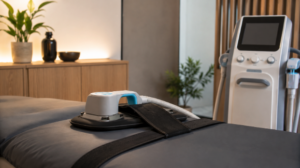
| EMSCULPT NEO | Muscle atrophy around a joint, post-injury weakness | Electromagnetic muscle stimulation builds supporting musculature | Not a direct joint or tendon treatment; it works on the surrounding muscle |
The table above reflects a real clinical reality: no single treatment wins across all conditions. The question isn’t which treatment is best in general. It’s the treatment that matches the specific stage and structure of your injury.
At Iron Mountain Orthopaedic Institute, this is exactly the kind of evaluation that happens before any treatment recommendation. The goal is never to default to the newest or most aggressive option. It’s to match the mechanism to the problem.
If you’re at the point where you’re comparing these options seriously, a direct conversation with Dr. Ayzenberg is worth more than any chart. Call (215) 821-7059 to schedule a consultation in Huntingdon Valley.
The Comparison Most People Miss: ESWT vs. PRP
These two get conflated constantly. They shouldn’t be.
PRP works at the cellular level. It delivers concentrated growth factors that recruit repair cells to damaged tissue. ESWT works at the structural and mechanical level. It breaks down calcification, disrupts fibrotic tissue, and restarts the vascular supply.
Consider a typical scenario: a patient with chronic Achilles tendinopathy has both a calcific deposit and surrounding tendon degeneration. ESWT addresses the calcific deposit directly. PRP addresses the surrounding tissue repair. Used together, they’re not redundant – they’re targeting different components of the same problem.
This is why combination protocols often outperform either treatment alone. The mechanism-matching logic applies here, too. If the primary problem is calcification, start with ESWT. If the primary problem is tissue quality and partial tearing, PRP is the stronger lead.
Who ESWT Is Not the Right Fit For
Honest medicine means saying this clearly.
ESWT is not appropriate for acute injuries in the first few weeks of the inflammatory phase. The tissue needs to stabilize before mechanical stimulation helps rather than harms. It’s also not the right primary treatment for significant cartilage loss or advanced osteoarthritis, where the structural problem is joint surface degradation rather than tendon pathology. For those patients, A2M, BMAC, or a combination approach is more appropriate.
Patients with certain circulatory conditions, active infections near the treatment site, or who are pregnant are not candidates. And for patients whose pain is coming from nerve compression or a structural issue that requires surgical correction, no regenerative treatment replaces that conversation.
The goal at Iron Mountain Orthopaedic Institute isn’t to avoid surgery at all costs. It’s to exhaust every legitimate non-surgical option before surgery is recommended. That distinction is what “less is more” actually means in practice.
The Decision Framework: Matching Treatment to Stage
The Stage-Mechanism Match is a practical way to think about which treatment to pursue first. It works like this: identify the primary tissue involved, the duration of the problem, and the dominant pathology (inflammation, degeneration, calcification, or muscle loss). Then match the treatment to the mechanism that addresses that specific combination.
- Use ESWT when: the condition is chronic (3+ months), the tissue is a tendon or fascia, and imaging shows calcification or fibrosis.
- Use PRP when: there’s partial tissue tearing, early-to-moderate joint arthritis, or a ligament that needs cellular repair stimulus.
- Use BMAC when: cartilage loss is moderate, and the patient wants to avoid or delay joint replacement.
- Use MLS Laser when: the primary complaint is acute pain, post-procedure recovery, or peripheral nerve pain.
- Use A2M when: early osteoarthritis is the diagnosis, and the goal is to slow enzymatic cartilage destruction.
Use EMSCULPT NEO when muscle atrophy around a joint contributes to instability or pain, and rebuilding that support structure is part of the recovery plan.
The framework isn’t a substitute for a clinical evaluation. But it gives you a starting vocabulary for the conversation you should be having with your orthopaedic surgeon.
Waiting to have that conversation is the most expensive decision in this category. Chronic tendon conditions and degenerative joint disease don’t plateau on their own – they progress, and the window for non-surgical options narrows with every month of delay.
If you’re in the Huntingdon Valley area and you’ve been managing joint or tendon pain without a clear plan, Iron Mountain Orthopaedic Institute offers the kind of appointment where you actually get answers. Dr. Ayzenberg takes the time to review your imaging, explain your options, and tell you honestly what’s likely to work. Call (215) 821-7059 or visit ironmountainortho.com.
Frequently Asked Questions
How many shockwave therapy sessions will I actually need?
Most protocols for chronic tendinopathy involve 3 to 5 sessions, spaced about one week apart. The number depends on the condition being treated and how the tissue responds after the first one or two sessions. Plantar fasciitis often responds in 3 sessions; calcific rotator cuff tendinopathy may need the full 5.
Will ESWT hurt during the treatment?
There’s real discomfort during the procedure, particularly over calcified tissue or bony prominences. Most patients describe it as an intense pressure or aching sensation. It’s brief and manageable, and it typically diminishes by the third session as the tissue begins to respond.
Can I do shockwave therapy and PRP at the same time?
Not simultaneously in the same session, but combination protocols are common and often clinically appropriate. The typical approach is to complete ESWT first to break down calcification and prepare the tissue, then follow with PRP to support cellular repair. Your surgeon should guide the sequencing based on your specific imaging and diagnosis.
How long before I see results from ESWT?
Tissue remodeling takes time. Most patients notice meaningful improvement between 6 and 12 weeks after completing their treatment course. Some feel better sooner; others take longer. Expecting immediate relief is the most common reason patients underestimate how well ESWT actually works.
Is shockwave therapy covered by insurance?
Coverage varies significantly by insurer and by the specific diagnosis code. Some plans cover ESWT for plantar fasciitis after documented failed conservative treatment; others classify it as investigational. It’s worth verifying with your insurance before scheduling, and Iron Mountain Orthopaedic Institute can help clarify what documentation is typically needed.
What happens if shockwave therapy doesn’t work for me?
If ESWT doesn’t produce adequate improvement, it doesn’t close off other options. Depending on the condition, PRP, BMAC, or a combination protocol may be the appropriate next step. Surgical consultation is appropriate when non-surgical options have been genuinely exhausted, and the structural problem requires direct repair. The point of a thorough non-surgical evaluation is to know exactly where you stand before that conversation.
How is ESWT different from ultrasound therapy?
Therapeutic ultrasound uses continuous or pulsed sound waves at low energy to warm tissue and mildly stimulate healing. ESWT uses high-energy acoustic pressure waves that create a mechanical stimulus strong enough to break down calcification and trigger a vascular response. They’re not the same mechanism, and they’re not interchangeable for chronic tendinopathy.
The right treatment isn’t the newest or the most aggressive. It’s the one that matches what your tissue actually needs right now. That’s a clinical judgment worth getting right.
About the Author
Mark Ayzenberg, MD, FAAOS, is the founder of Iron Mountain Orthopaedic Institute and a double board-certified, fellowship-trained orthopaedic surgeon specializing in sports medicine, arthroscopy, and regenerative orthopaedics. He graduated cum laude from the University of Pennsylvania, earned his medical degree with highest honors from what is now Geisinger Commonwealth School of Medicine, and completed fellowship training in Sports Medicine, Arthroscopy, and Reconstructive Surgery at Southern California Orthopedic Institute. Iron Mountain Orthopaedic Institute serves patients throughout Huntingdon Valley, PA, with a focus on minimally invasive and non-surgical solutions for joint pain, tendon conditions, and sports injuries.