By Mark Ayzenberg, MD, FAAOS, Founder, Iron Mountain Orthopaedic Institute
Chronic tendon pain has a way of outlasting everything you throw at it. You’ve rested it, iced it, stretched it, done the physical therapy, maybe taken the cortisone shot. And it’s still there, every morning, every round of golf, every time you try to keep up with your grandkids.
Direct Answer
Extracorporeal shockwave therapy (ESWT) is a non-surgical, in-office treatment that delivers targeted acoustic energy into damaged tendons and soft tissue to restart the body’s healing process. For appropriate candidates, it produces meaningful pain reduction and functional improvement, typically over 6 to 12 weeks. Results vary based on injury type, chronicity, and how the treatment is applied.
Key Takeaways
- ESWT works by triggering a controlled biological response in tissue that has stopped healing on its own, not by masking pain
- The strongest results come from chronic tendinopathies (plantar fasciitis, Achilles, patellar, rotator cuff) that haven’t responded to standard conservative care
- Most patients need 3 to 5 sessions; improvement builds gradually over weeks, not immediately after the first treatment
- Temporary soreness after each session is normal and expected, not a sign the treatment isn’t working
- ESWT is not appropriate for acute injuries, active infections, or patients on certain blood thinners
Why Does Chronic Tendon Pain Stop Responding to Normal Treatment?
Most people assume that rest and time fix tendon injuries. For acute injuries, that’s often true. But chronic tendinopathy is a different animal.
When a tendon is repeatedly stressed without adequate recovery, the tissue undergoes a process called failed healing. The body attempts repair but produces disorganized collagen, inadequate blood supply, and scar tissue rather than functional tendon fibers. At that point, the injury isn’t really “inflamed” in the traditional sense. It’s structurally compromised.
This is the core problem: once a tendon enters the failed-healing state, standard anti-inflammatory treatments stop working because inflammation is no longer the primary driver. Cortisone shots reduce inflammation. But if the tendon’s problem is structural degradation rather than active inflammation, you’re treating the wrong thing.
Ice and rest don’t fix disorganized collagen. Physical therapy helps, but has limits when the tissue itself lacks the biological machinery to respond. The tendon needs a stimulus strong enough to restart the repair cycle from the beginning.
That’s the gap ESWT fills.
How Does ESWT Actually Work? The Mechanism Behind the Results
Extracorporeal shockwave therapy is the delivery of high-energy acoustic waves to targeted tissue via the skin, with no incisions or anesthesia required.
The mechanism isn’t pain blocking. It’s a biological provocation.
When acoustic energy reaches damaged tendon tissue, it creates controlled microtrauma at the cellular level. That microtrauma triggers a cascade: increased blood flow to the area, recruitment of growth factors including TGF-beta and VEGF, stimulation of tenocyte activity (the cells responsible for collagen production), and breakdown of calcific deposits when they’re present.
In plain terms, the shockwaves tell the body that this tissue needs attention, and the body responds by sending the repair resources it had stopped sending. You’re not numbing the problem. You’re restarting the stalled process.
This is also why some soreness after treatment is expected and normal. A treatment that provokes a healing response will, by definition, provoke some temporary discomfort. Patients who expect zero pain after each session often misread normal post-treatment soreness as a bad sign.
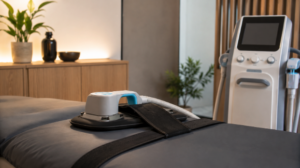
At Iron Mountain Orthopaedic Institute, ESWT is performed in-office in 10 to 20 minutes per session, with no downtime required.
What Does Strong vs. Weak Results Actually Look Like?
This is the question most patients don’t get a straight answer to before starting treatment. Here’s what the evidence actually shows.
Strong results look like this:
Consider a typical case: someone with plantar fasciitis for 14 months who has completed physical therapy and received two cortisone shots without lasting relief. After a course of ESWT (3 to 5 sessions over several weeks), meaningful reduction in morning heel pain and improved walking tolerance by weeks 8 to 12. Not zero pain on day one. Gradual, building improvement over the treatment window.
The conditions that predict strong results: injury duration of 3 months or longer, failure of at least one prior conservative treatment, intact tendon structure (no complete tear), and a patient who can tolerate the treatment sessions and follow activity guidance between them.
Weak results look like this:
ESWT applied to an acute injury (less than 6 weeks old) often underperforms because the body’s natural healing process is still active and doesn’t need the stimulus. Applying it too early is like shouting at someone who’s already working.
Weak results also occur when the diagnosis is wrong. ESWT is highly specific. It works on the conditions it’s designed for. If your heel pain is due to nerve entrapment rather than plantar fasciitis, shockwave therapy won’t help because you’re treating the wrong tissue entirely.
The single biggest predictor of poor outcomes isn’t the treatment. It’s the wrong diagnosis applied to the right treatment.
If you’ve been managing chronic tendon pain in the Huntingdon Valley area and haven’t gotten a clear picture of whether ESWT fits your situation, a consultation with Dr. Ayzenberg can give you that answer without any commitment to a treatment path.
Call Iron Mountain Orthopaedic Institute at (215) 821-7059 to schedule.
The ESWT Candidate Framework: When It’s the Right Call and When It Isn’t
The ESWT Candidate Framework is a decision structure for identifying which patients are likely to benefit from shockwave therapy based on injury chronicity, prior treatment history, and tissue integrity.
Use it like this:
ESWT is likely appropriate when:
- Symptoms have persisted for 3 months or more
- At least one prior conservative treatment (PT, cortisone, bracing) has failed
- Imaging confirms tendinopathy without complete structural rupture
- The condition is one of the well-studied indications: plantar fasciitis, Achilles tendinopathy, patellar tendinopathy, calcific rotator cuff tendinitis, and lateral epicondylitis
ESWT is not the right tool when:
- The injury is acute (under 6 weeks)
- There’s an active infection or tumor in the treatment area
- The patient is pregnant
- The patient is on anticoagulation therapy (requires individual evaluation)
- The tendon is completely torn (ESWT stimulates healing in damaged tissue, not bridging of a structural gap)
The framework isn’t complicated. But it requires an accurate diagnosis first. That’s the step that determines everything downstream.
How Does ESWT Compare to Other Non-Surgical Options?
| Treatment | Mechanism | Timeline to Results | Downtime | Best For |
|---|---|---|---|---|
| ESWT | Acoustic energy restarts biological repair | 6 to 12 weeks | None | Chronic tendinopathy, failed PT |
| Cortisone Injection | Reduces active inflammation | Days to weeks | Minimal | Acute inflammation, short-term relief |
| PRP (Platelet-Rich Plasma) | Growth factors from your own blood stimulate repair | 8 to 16 weeks | Minimal | Moderate to severe tendinopathy, partial tears |
| Physical Therapy | Load management and tissue remodeling | Weeks to months | None | Acute and subacute injuries, post-procedure rehab |
| Surgery | Structural repair or debridement | Months of recovery | Significant | Complete tears, failed all conservative options |
The comparison that matters most isn’t ESWT versus PRP or ESWT versus cortisone. It’s any of these options versus waiting and doing nothing, which allows structural degradation to progress and narrows the window for non-surgical solutions.
Waiting doesn’t preserve your options. It reduces them.
At Iron Mountain Orthopaedic Institute, ESWT is often used alongside PRP or as part of a sequenced regenerative treatment plan, depending on the injury and the patient’s goals.
Who Shouldn’t Expect ESWT to Solve Their Problem?
Honest answer: ESWT isn’t a universal fix, and knowing its limits is part of using it well.
It doesn’t work on complete tendon ruptures. It doesn’t address underlying biomechanical problems that caused the injury in the first place (those need to be corrected separately or the injury recurs). It won’t produce results in one session, and patients who expect dramatic change after the first treatment almost always misinterpret the process.
It also isn’t the right starting point for someone with a new injury. If you’ve had heel pain for three weeks, rest and physical therapy are the correct first steps. ESWT earns its place when those steps have already been tried, and the tissue hasn’t responded.
The goal at Iron Mountain Orthopaedic Institute isn’t to apply every available treatment. It’s to apply the right treatment at the right time for the specific injury in front of us.
Frequently Asked Questions
How many shockwave therapy sessions will I actually need?
Most patients complete 3 to 5 sessions, spaced approximately one week apart. Some conditions, particularly calcific tendinitis, may require additional sessions. The number depends on injury severity and on how your tissue responds after the first two treatments, which provides the treating physician with early feedback on your response trajectory.
Is shockwave therapy painful during the treatment?
There’s typically a strong pressure sensation and some discomfort during the session, particularly over the most damaged tissue. Most patients tolerate it without anesthesia. The intensity can be adjusted based on your feedback during treatment. Post-session soreness for 24 to 48 hours is normal and expected.
How long before I notice improvement after ESWT?
Don’t expect dramatic change after the first session. Most patients begin noticing real improvement between weeks 4 and 8, with the full effect continuing to build through week 12 as the biological repair process completes. The treatment triggers a cascade that unfolds over time, not a switch that flips immediately.
Can I keep exercising or playing sports while doing shockwave therapy?
Light activity is generally fine between sessions. High-impact loading of the treated area is usually restricted for 48 hours post-treatment. Your specific activity guidance will depend on which tendon is being treated and how your body is responding. Returning to golf or sport is often a realistic goal within the treatment window, not after it.
Will insurance cover ESWT?
Coverage varies significantly by insurer and plan. Some insurers cover ESWT for specific indications, such as plantar fasciitis, when conservative treatments have been documented as failing. Others classify it as experimental. The office team at Iron Mountain Orthopaedic Institute can help you understand your specific coverage before committing to a treatment plan.
What happens if ESWT doesn’t work for me?
If ESWT doesn’t produce the expected improvement, that information is clinically useful, not a dead end. It may indicate the diagnosis needs re-evaluation, that the injury has progressed beyond what shockwave therapy can address alone, or that a different regenerative approach (such as PRP or BMAC stem cell therapy) is the better next step. Non-response guides the next decision rather than closing the door on non-surgical care.
Is shockwave therapy the same as ultrasound therapy?
No. Therapeutic ultrasound uses low-energy sound waves primarily for warming and mild tissue stimulation. ESWT uses high-energy acoustic pulses to generate cellular-level mechanical stress that triggers the biological repair cascade. They’re in the same general category of sound-based therapies but operate at different energy levels, use different mechanisms, and have different clinical indications.
The Straight Answer on ESWT
The patients who get the most from ESWT are the ones who’ve already tried the standard path and hit a wall. If you’ve done the physical therapy, taken the injections, rested it longer than anyone should have to, and the tendon still isn’t right, that’s exactly the situation shockwave therapy was designed for.
It’s not a shortcut. It’s a restart.
If you’re in the Huntingdon Valley area and you’re tired of managing pain that won’t resolve, the next step is a real conversation about whether ESWT is right for your specific injury, not a generic treatment plan handed to you after a 10-minute appointment.
Iron Mountain Orthopaedic Institute was built on the premise that longer appointments, accurate diagnosis, and conservative-first care produce better outcomes than rushing to the operating room. Dr. Ayzenberg holds a 5.0 Google rating because that approach works.
Call (215) 821-7059 to schedule a consultation and find out whether ESWT is the right next step for you.
About the Author
Mark Ayzenberg, MD, FAAOS, is the founder of Iron Mountain Orthopaedic Institute and a double board-certified, fellowship-trained orthopaedic surgeon specializing in sports medicine, arthroscopy, and regenerative orthopaedics. He graduated cum laude from the University of Pennsylvania, earned his medical degree with highest honors (first in his class) from what is now Geisinger Commonwealth School of Medicine, and completed fellowship training in Sports Medicine, Arthroscopy, and Reconstructive Surgery at Southern California Orthopedic Institute. Iron Mountain Orthopaedic Institute serves patients in Huntingdon Valley, PA, with a conservative-first approach that prioritizes non-surgical solutions and personalized care.